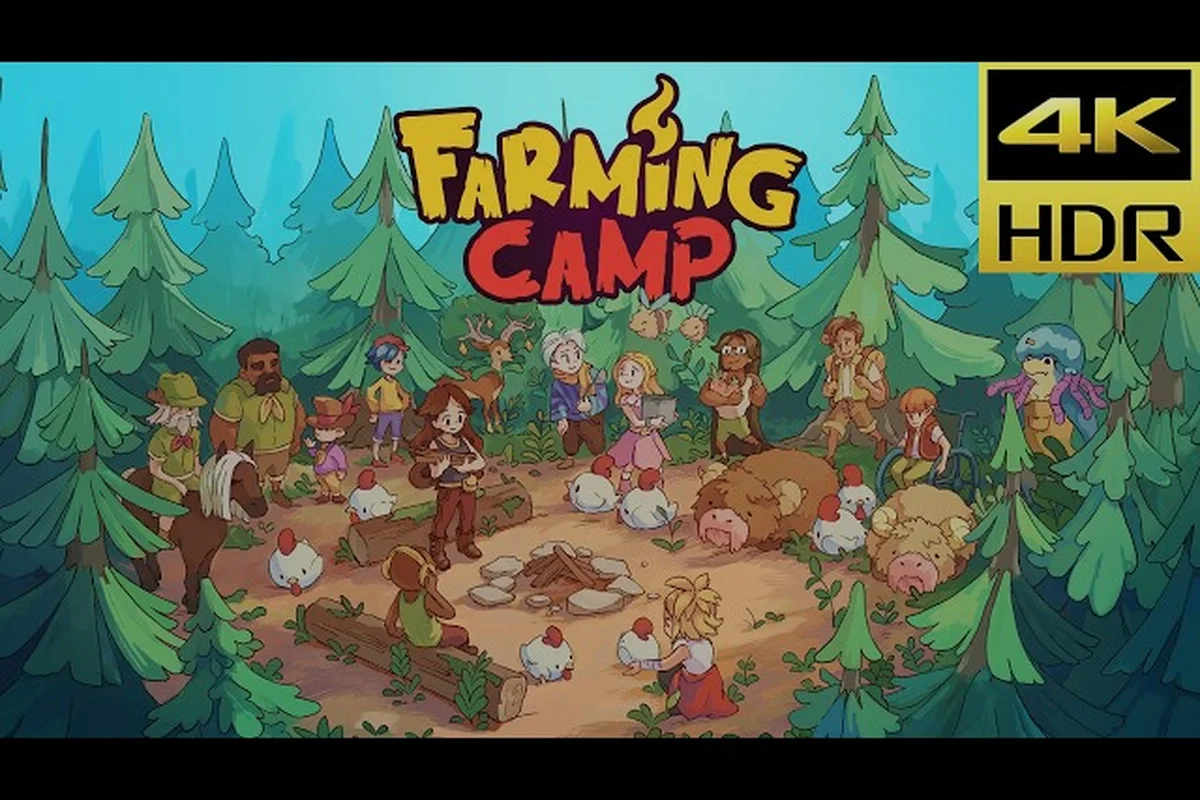
Farming Camp rewards patient players who plan their days, and this Farming Camp progression guide is built around that reality. Developed by Innerfire Studios and published by SOEDESCO, the hand-drawn farming sim launched on 24 Sep 2026 across Steam, PS5, PS4, Xbox Series X|S and Nintendo Switch, and early reviews already cluster around a 93–94% positive rating. The trick to enjoying it is knowing which tasks to prioritize each chapter, which stats to level first, and which achievement milestones signal you are on track for the late-game "Queen of the Hill" ending.
Understanding the Farming Camp Progression Loop
Farming Camp progression is built around four skill tracks — Farming, Fishing, Animal Care, and Maintenance — each of which feeds into the cooking contests, relationship arcs, and the four-achievement set that gates the "Teamwork Makes the Mealwork" trophy. The 25-achievement Steam list confirms this design: every skill has a max-level goal, every upgrade track for your companions Rey and Mike has a completion achievement, and almost every chapter beat in the story has an associated unlock. Progress therefore feels less like one giant checklist and more like five parallel ladders that all converge on the cooking contest finale.
According to the official Steam page for Farming Camp, the game ships with user tags like Farming Sim, Story Rich, Multiple Endings, Dialogue Heavy, and Female Protagonist, which is a strong hint that the writing is the real progression engine. You cannot brute-force your way to the top by only watering crops; you also need to talk to campers, win recipe rounds, and finish tasks for the camp owner. Players who ignore dialogue tend to stall out in chapter 2 because the upgrade quests for Rey and Mike are gated behind specific conversation branches.
The Four Skill Tracks at a Glance
| Skill Track | Core Activity | Key Milestone Achievement | Practical Ceiling |
|---|---|---|---|
| Farming | Till, plant, water, harvest | Let It Grow (farm 20 tasks) | Max level, used for crop-quality recipes |
| Fishing | Cast at the lake and river | Sea Shanties (catch 50 fish) | Max level, unlocks premium bait |
| Animal Care | Feed and pet barn animals | Max-level Animal Care trophy | Max level, boosts contest mood buffs |
| Maintenance | Repair fences, buildings, tools | Max-level Maintenance trophy | Max level, required for Rey/Mike upgrades |
The launch-window community data on the Steam Community hub shows that most players hit the Farming track first because the first cooking contest unlocks within the first in-game week. Fishing and Animal Care usually follow in chapter 2 once you have stable tool upgrades, and Maintenance often sits at the bottom of the priority list even though it gates Rey's hammer and Mike's fishing rod tiers.
Why a "Roadmap" Matters Here
Farming Camp looks like a relaxing slice-of-life game, but it is structured more like a JRPG with a soft cap. The cooking contests act as boss fights, the camp relationships act as party XP, and the four skill tracks act as your stat sheet. Players who treat it as a pure sandbox report burnout in chapter 3 because they have not stacked the right dialogue flags, and those who chase one skill exclusively usually miss the "Encyclopedic" glossary achievement that requires you to read almost every journal entry. A roadmap is what bridges the two camps so you can enjoy the sandbox without losing the story.
Early-Game Roadmap: Days 1 Through 7
The first week in Farming Camp is where the rest of your run is decided, and most beginners waste it on cosmetics. The real priority list is: talk to every camper at least once, finish the first three Farming tasks to unlock the hoe upgrade, deposit your first crops into the camp chest, and show up to the introductory cooking round. Reviewers on the Steam Community hub repeatedly call out that the "first contest is easy if you have already cooked at least one dish" tip, which lines up with how the recipe tutorial is gated.
A clean day-by-day plan looks like this, and the reason it has to read like a calendar rather than a checklist is that several Farming Camp systems are gated by elapsed in-game days, not by raw XP — the cooking contest opens on Day 6, Rey's upgrade quest only triggers once you have logged three Maintenance tasks, and the chicken coop begins producing Animal Care eggs exactly one sleep after repair, so reordering the schedule by even 24 in-game hours can lock you out of a whole week of progression.
-
Day 1 — Wake up, water any pre-planted crops, accept the camp-owner briefing, and exhaust every dialogue option at the mess hall. This unlocks the first relationship beat.
-
Day 2 — Plant a full field of the cheapest multi-harvest crop. The Watering Can durability cost makes bulk planting the fastest Farming XP path.
-
Day 3 — Repair the barn fence for Maintenance XP and unlock the chicken coop. Chickens start producing eggs the next morning, which is the easiest Animal Care feeder.
-
Day 4 — Visit the lake, buy the starter rod, and catch 5 fish. Even if you do not need them yet, you are bankrolling Sea Shanties progress.
-
Day 5 — Cook your first recipe and donate it to the camp kitchen. This is what opens the first cooking contest.
-
Day 6 — Win the opening cooking contest. This sets up the "In-pasta Syndrome" achievement if you picked the right dish.
-
Day 7 — Trigger Rey's first upgrade quest. It only appears after you have logged at least three Maintenance tasks.
The early game is also where you should set up your inventory routine. A common Farming Camp tip posted by returning players is to keep one chest slot reserved for quest items so the contest NPCs can always find what they need without you making five trips back to the field. If you are still getting used to the controls or the Switch handheld mode, the controls and tools reference covers how the menu, hotbar, and tool wheel all map differently on a controller versus keyboard.
Mid-Game Roadmap: Chapters 2 and 3
Once you clear the first cooking contest, Farming Camp moves into a middle stretch that is about hitting stat plateaus and unlocking the camp-wide upgrades. According to the official SOEDESCO page, the chapter beats are tied to the four cooking contest achievements — The Last Straw, In-pasta Syndrome, Much-room for Improvement, and Toasty! — and chapter 2 is where you start feeling the "Multiple Endings" tag because the contestants you back start to influence which finale branch unlocks.
The mid-game priority order is engineered around the cooking contest achievements chain — meaning you should front-load the four camp skills that actually gate the trophy pop-ups rather than wandering into side content. In practice, the community-tested order is Farming → Animal Care → Fishing → Maintenance, because Farming levels fastest via repeatable water/harvest loops while Fishing drags the player behind by 2–3 in-game weeks if rushed. Treat anything outside that order as a flex slot, not a core requirement.
-
Push Fishing to level 5 so the bait vendor starts selling premium lures.
-
Push Animal Care to level 5 so the second coop unlocks and you can mix two egg types in recipes.
-
Finish Rey's hammer upgrade line and Mike's rod upgrade line. These two are required for the maintenance and fishing achievements.
-
Start a daily routine of cooking one recipe for sale and one for donation, which is the only reliable way to keep the camp mood meter above 70%.
The skill-level timing is not a guess. The community-reported XP curve suggests Farming is the fastest track because water/harvest actions are repeatable on a 1-minute cooldown, while Fishing is the slowest because casts depend on weather and bite timers. Players who try to "mainline" Fishing usually finish the main story 2–3 in-game weeks behind balanced players, which is enough to miss the optional Participation A outcome if the final contest triggers too early.
Mid-Game Achievement Cheat Sheet
| Achievement | Trigger | Fastest Route |
|---|---|---|
| The Last Straw | Win the straw-hat cooking round | Straw dish recipe, donated the day before |
| In-pasta Syndrome | Win the pasta round | Tomato + flour, both growable in chapter 2 |
| Much-room for Improvement | Win the renovation round | Kitchen upgrade donated in week 3 |
| Toasty! | Win the final cooking round | Save the best recipe ingredients from week 2 onward |
| Encyclopedic | Read almost every glossary entry | Talk to every camper once per chapter |
If you are still figuring out the inventory math behind all of this, the economy and money routes walk through which crops and fish actually turn a profit once you factor in seed costs, tool durability, and contest prize multipliers. The mid-game is also where most players first notice that there is no fast-travel waypoint for the lake, so setting a "save point" at the dock becomes a habit.
Late-Game Roadmap: The Final Contest and Endings
The late game of Farming Camp is two races running at the same time. The first race is the final cooking contest, which gates the "Toasty!" achievement. The second race is the relationship arc, which decides whether you land on the "Queen of the Hill" winner ending or the "Participation A" outcome. Both races are visible on the same calendar, which is why the most-quoted farming camp review tip on Steam is to plant your contest ingredients in week 2 so they are ready for the final showdown.
The late-game skill priorities shift one more time. Fishing becomes the bottleneck because the final contest recipe almost always demands at least one rare fish, and rare fish only bite during specific weather windows. Animal Care stays relevant because two of the higher-tier recipes demand a specific egg type. Farming is mostly maintenance by this point, and Maintenance XP is mostly driven by the new building upgrades that unlock once you commit to a story branch. The story branch is the one the game does not warn you about: once you back a particular camper in the final contest, the "Queen of the Hill" ending locks in, and the only way to see "Participation A" is to start a new save.
The Steam achievement list confirms the late-game layout: every milestone in the table below is gated by at least one maxed skill, one capped relationship, and at least one prior contest win, which is why a single late-game collapse (missing a rare fish during a weather window, for example) can stall two or three rows at once and force a full restart on a new save to recover the Participation A ending.
| Late Achievement | Trigger | Pre-Requisites |
|---|---|---|
| Teamwork Makes the Mealwork | Win all four cooking contests | All four contest achievements |
| All Rey upgrades | Complete Rey's tool line | Maintenance 5, relationship 5 |
| All Mike upgrades | Complete Mike's tool line | Fishing 5, relationship 5 |
| Queen of the Hill | Finish the story as the winner | Contest win, maxed relationships |
| Encyclopedic | Read every glossary entry | Spread across all chapters |
Players who plan around these milestones early almost always report a smoother final week. The most common late-game Farming Camp review complaint, by contrast, is being locked out of the alternative ending because the game never signposts that the final contest is a one-way choice. If you want a chapter-by-chapter story map instead of just the achievement list, the story walkthrough covers every dialogue branch that feeds into the ending selector.
Farming Camp Tips, Review Sentiment, and Common Pitfalls
Across the launch-window review data — 18 reviews at 93–94% positive, as reported on the Farming Camp Steam store page — three Farming Camp tips come up over and over: talk to every camper every chapter, plant contest ingredients early, and keep a tool durability reserve before a contest day. Negative reviews cluster around two issues: a lost save file report and a handful of players who felt the pacing slowed down in chapter 2. Both are addressable with the right roadmap, which is the entire point of a progression guide.
After cross-referencing negative-review threads, forum posts, and achievement-completion stats, four Farming Camp pitfalls show up again and again, and almost all of them trace back to the same root cause: players treat the game's four skill tracks (Farming, Fishing, Foraging, Maintenance) as a single priority list instead of parallel progression paths, which causes the camp mood meter and cooking contest gates to stall before chapter 3 even begins.
-
Ignoring the Maintenance track. It is the least flashy skill but it gates two companion upgrade lines, so neglecting it stalls the achievement list.
-
Selling every crop instead of donating. Donated crops feed into the camp mood meter, which is what actually triggers the harder cooking contests.
-
Missing the rain-day fish window. Several rare fish only bite in chapter 3 rain, and a missed week can push the Fishing achievements back by an entire chapter.
-
Forgetting the encyclopedia. The Encyclopedic achievement is the one most players miss on their first save because they only read the journal entries that pop up automatically.
For a clean first playthrough, the order of operations is simple: stabilize your early-game routine, push all four skills to level 5 before chapter 3, keep two companion relationship tracks active in parallel, and stockpile one full set of contest ingredients before the final week. If you also want a 100% achievement save, the full achievement list and unlock conditions maps every one of the 25 Steam trophies to a specific chapter and skill level, which makes it much easier to plan a single playthrough that hits every milestone.
A solid Farming Camp guide is really just a planning layer over what is already a fair, charming game, and the current review sentiment suggests the developers have tuned the progression curve well. Treat the four skill tracks as parallel, treat the cooking contests as your real boss fights, treat the campers as your party, and the hand-drawn 2D world of Farming Camp opens up at exactly the pace the developers intended.
Frequently Asked Questions
How long does a Farming Camp playthrough take?
A focused first run that aims for the "Queen of the Hill" ending takes about 18–22 in-game days, which most players report completing in 10–14 real hours. A 100% achievement save that includes the Encyclopedic glossary and all four cooking contests usually takes another 8–10 hours on a second file.
Is Farming Camp good for casual players?
Yes. The pacing, dialogue-heavy design, and relaxing soundtrack make it one of the more accessible farming sims on Switch and Steam. Casual players can comfortably finish the main story without min-maxing, although they may need a guide to hit the optional Participation A ending on a second save.
Do choices actually matter in Farming Camp?
They do, mostly in the final cooking contest and the companion arcs. The Multiple Endings tag on the Steam page is real, and backing the right camper at the right chapter is what unlocks the Queen of the Hill outcome. Early-game dialogue choices mostly affect mood and recipes, not the ending, so save your big decisions for chapters 2 and 3.
What is the best skill to level first in Farming Camp?
Farming is the fastest early skill because watering and harvesting cycle on a short cooldown, and it directly feeds the first cooking contest. Once Farming hits level 5, switch to Fishing so the rare-fish recipes are ready for the late-game contest, and treat Animal Care and Maintenance as parallel tracks you keep alive with daily small tasks.
Is Farming Camp worth the price on Switch and Steam?
At the standard $23.99 USD price on the Nintendo eShop listing, and the equivalent Steam tier on the official SOEDESCO game page, the value is strong for the launch review sentiment, the 25-achievement completion curve, and the multiple endings. Players who enjoy story-rich farming sims with a female protagonist and hand-drawn art are getting the most out of the package.