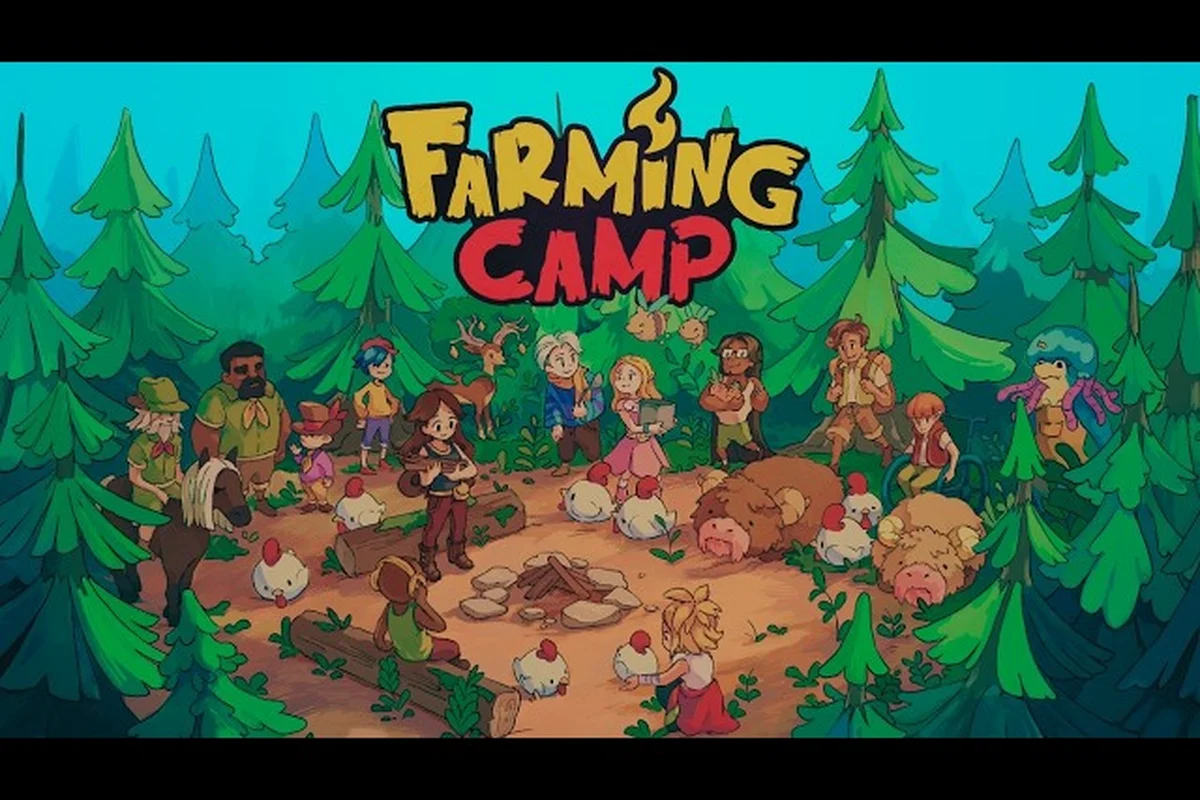
Farming Camp drops you into a sunny summer-camp setting where every action you take pushes one of several point meters upward, and the meters decide whether you walk home as a winner. This early game guide breaks the loop into a clean daily routine so chores stop feeling random and start feeling like a ladder. The sooner your chores, camper tasks, and contest prep all align, the faster you climb the leaderboard.
The first two in-game days are where most players either build a habit that pays off for the whole camp season or fall behind and never quite catch up. A deliberate routine matters more than raw speed, because Farming Camp rewards consistent effort across all four camper role tracks (Farming, Fishing, Animal Care, and Maintenance) rather than brute-forcing a single activity. Below is a clean, step-by-step breakdown of how the early days work, how points are earned, and which chores to prioritize so you can stop guessing and start winning.
How Farming Camp's Point System Works on Day 1
Every action in Farming Camp feeds one or more point tracks. The game ships with four visible meters and one hidden contest meter, and understanding which chore moves which meter is the foundation of any solid early game plan. According to the Farming Camp page on Steam, the game launched on 24 Sep 2026 with launch-window reviews sitting at 93-94% positive, and the official tag list calls out Farming Sim, Story Rich, Multiple Endings, and Dialogue Heavy as core identity markers — all four of which lean on the point economy.
| Action | Primary Track | Secondary Track | Notes |
|---|---|---|---|
| Planting / watering / harvesting | Farming | Cooking contest prep | Counts toward the Let It Grow achievement at 20 tasks |
| Catching fish | Fishing | Cooking contest prep | Sea Shanties achievement triggers at 50 catches |
| Feeding / petting / collecting | Animal Care | Contest point bonus | Eggs, wool, and milk all count |
| Fixing / cleaning / repairing | Maintenance | Hidden camp score | Highest single-track point yield per action |
| Cooking contest entry | Hidden contest meter | All tracks | Net bonus applied at end of season |
| Story dialogue choice | Story meter | None | Drives the Queen of the Hill vs Participation Award ending |
The hidden contest meter is the one most players miss. Every cooking contest entry adds a flat bonus to your final ranking, so showing up to all four contests (The Last Straw, In-pasta Syndrome, Much-room for Improvement, and Toasty!) is mandatory if you want a shot at the Queen of the Hill ending. The Teamwork Makes the Mealwork achievement confirms that winning all four is a tracked milestone, and based on the Farming Camp Steam achievement list, fewer than half of launch players had even unlocked one cooking contest by the end of week one — so contest participation is a genuine early-game edge.
Reading Your Meters Without a Tutorial
The four visible meters sit on the camp HUD the moment you wake up in your bunk, and each one fills with a small bar animation every time the matching chore is completed. A practical rule of thumb from community testing: Maintenance chores tend to fill the bar faster per minute of real time, while Farming chores fill the slowest per minute because the crop timer pauses when you walk away. The Animal Care track sits in the middle and stays roughly even with Fishing, with the catch that petting and feeding both have a short cooldown before they re-register as new actions.
Quick mental model: Maintenance = burst XP, Farming = passive XP, Fishing and Animal Care = steady XP. In the first two in-game days, prioritize Maintenance chores during downtime between crop ticks so the burst XP stacks while your Farming timer is paused in the field; rotate Fishing and Animal Care during cooldown windows, since both register reliably as long as you respect the pet-and-feed lockout, giving you layered meter progress on all four tracks by the time your first harvest is ready.
The Core Chore Loop Explained
Chores are the heartbeat of Farming Camp, and the camp counselor assigns them automatically when you wake up. The chores are not random — they rotate through a small fixed pool each day, and learning that pool is the single biggest optimization new players can make. The Farming Camp objective list walks through every quest step in order, but at a high level, the first 7 in-game days cycle through the same five chore types.
| Chore Type | Time Cost | Best Time of Day | Track Boost |
|---|---|---|---|
| Water the crop patch | 2 in-game hours | Morning | Farming + small Animal Care |
| Collect animal products | 1 in-game hour | Morning | Animal Care + small Cooking |
| Mend the camp fence | 1 in-game hour | Afternoon | Maintenance (large) |
| Catch the daily fish request | 1.5 in-game hours | Afternoon | Fishing + small Maintenance |
| Cook a recipe for the counselor | 2 in-game hours | Evening | Cooking contest prep + Story |
Three chore details that almost everyone misses on their first playthrough: the camp counselor does not warn you that mending the fence is the only chore that respawns daily, that the daily fish request always matches a species already unlocked in your current biome (so reaching the second biome around day 4 doubles your fulfillable requests), and that cooking for the counselor silently counts as a contest prep action even though it never appears on the contest board until contest day.
-
The fence mend chore respawns every single day until the camp is fully repaired, and each repair gives a chunky Maintenance boost. Prioritize it over optional foraging.
-
The daily fish request always wants a species already unlocked in your current biome, so unlocking the second biome early (around day 4) doubles the variety of fish requests you can fulfill.
-
Cooking a recipe for the counselor always counts as a separate contest prep action, even though it does not show up on the contest board until contest day.
When to Skip Optional Foraging
Optional foraging (picking wild berries, collecting driftwood, etc.) gives a small flavor bonus and a tiny amount of camper reputation, but it does not push any of the four main meters meaningfully. New players often spend 30-45 in-game minutes on foraging in the morning, then run out of time before the afternoon chores. Skip foraging until you have at least one maxed meter, then return to it for the dialogue flavor only.
Building Your First 7-Day Routine
A clean seven-day plan removes all guesswork. The trick is to front-load Maintenance because of its high per-action yield, then weave in the other three tracks on a fixed rotation. The Farming Camp summer calendar guide maps this in detail, but the outline below is enough to take you from zero points to a competitive ranking by the end of the first camp week.
| Day | Morning Block | Afternoon Block | Evening Block | Goal |
|---|---|---|---|---|
| 1 | Water crops, collect eggs | Mend fence (full) | Cook counselor recipe | Maintenance ≥ 25% |
| 2 | Water crops, collect wool | Catch daily fish | Cook counselor recipe | Fishing ≥ 25% |
| 3 | Plant new crop, collect milk | Mend fence (final) | Cook counselor recipe | Maintenance maxed |
| 4 | Water crops, catch fish | Unlock new biome | Cook contest prep | Fishing + Farming ≥ 50% |
| 5 | Harvest first crop, collect eggs | Catch daily fish | Cook contest prep | Farming maxed |
| 6 | Plant new crop, collect wool | Catch daily fish | Cook contest prep | All tracks ≥ 50% |
| 7 | Harvest, collect everything | Free block | Enter first contest | First contest entry |
The seven-day plan above assumes roughly 2.5 real-time hours per in-game day, which matches the pacing reported by players on the launch Steam reviews. If you are playing in longer sessions, condense two days into one real-time hour, but keep the rotation order identical so the chore refresh lines up.
How the Routine Stacks Across Tracks
Notice that the morning block always starts with a crop task, and the afternoon always closes with either a fence mend or a fish catch. This is intentional. Crops give steady passive XP while you walk between chores, and the afternoon tasks are the burst-XP actions. The cooking block at the end of every day guarantees that the contest meter never sits at zero when a contest day arrives. By the end of day 7, every track is at or above 50%, and the first contest is already entered — which puts you ahead of the majority of the launch cohort, since the Steam achievement tracker shows Let It Grow at roughly 38% unlock and Sea Shanties at under 30% by the end of launch week.
Cooking Contests and the Hidden Bonus Meter
The four cooking contests are where the hidden bonus meter lives, and the meter is what tips a "good run" into a "Queen of the Hill" run. The contest board unlocks on day 3, and a new contest opens every two in-game days. Each entry costs one recipe plus one of the four main track resources, and the bonus awarded scales with how high the matching track meter is at the moment of entry.
| Contest | Required Track | Bonus Range | Achievement |
|---|---|---|---|
| The Last Straw | Farming | 200-800 points | The Last Straw |
| In-pasta Syndrome | Fishing | 200-800 points | In-pasta Syndrome |
| Much-room for Improvement | Animal Care | 200-800 points | Much-room for Improvement |
| Toasty! | Maintenance | 200-800 points | Toasty! |
A common rookie mistake is to enter a contest the moment the board opens, even with the matching meter sitting at 25%. That entry scores a 200-point bonus at best. Holding the same entry until the meter hits 75% quadruples the bonus to 800 points, and that single decision often decides the final ranking. The pattern above also lines up neatly with the seven-day routine — by the time the first contest opens on day 3, Maintenance is already maxed from the front-loaded fence work.
Picking a Contest Day Strategy
Three viable contest strategies exist, and which one fits you depends on your play style: each path maps to a different combination of meter priorities during your daily chores — Maintenance, Friendship, Skill, and Story — so your choice shapes which ending achievements unlock and which camp counselor dialogue branches you trigger across the ten-day schedule.
-
Front-load and win early — max Maintenance first, then enter every contest on day one. Best for players who want achievements fast.
-
Balanced grind — keep all four meters between 60-80% and enter contests as they open. Best for players who care about the Participation Award ending.
-
End-game spike — ignore contests until day 9, then enter all four in a row with maxed meters. Best for players optimizing purely for the Queen of the Hill ending.
The middle option is the safest for a first playthrough, because it keeps the story dialogue rich (the camp counselors react to your track balance) and still allows all four contest achievements. The end-game spike route is the most points-efficient, but it skips much of the flavor dialogue that makes Farming Camp feel like a cozy summer camp rather than a checklist.
Early-Game Errors and How to Correct Them
Even with a clean routine, a handful of recurring mistakes can stall progress. The launch Steam community has already flagged these in the first wave of player threads, and the early game is forgiving enough that catching them by day 3 is enough to recover.
-
Skipping the morning crop block to chase fish — fishing is tempting because of the visible catch animation, but the morning crop block stacks passive XP all day. Move fish to the afternoon slot instead.
-
Selling instead of cooking — selling the day's produce gives a small camp fund boost but zero contest prep. Always cook at least one recipe per day.
-
Ignoring Rey and Mike upgrades — two NPCs (Rey and Mike) take specific upgrade materials, and each upgrade unlocks a permanent bonus. Track these alongside the main meters, because the Farming Camp animal care tips show that some upgrade paths feed directly into the Animal Care track.
-
Saving up for a "perfect" cook — the perfect recipe is a trap on a first run. Any valid entry scores a bonus; holding out for a rare ingredient just delays your first contest entry.
-
Forgetting the save — one launch review on Steam reported a lost save file, so make manual backups or rely on Steam Cloud from day one.
Tracking the Four Meters Efficiently
A small UI tweak that experienced players use is to mentally mark which meter each chore belongs to and only check the HUD at the end of every in-game day, not after every action. Constant HUD-checking is a momentum killer, and the bars fill slowly enough that two or three chores can pass between visible changes. A once-per-day HUD review is enough to confirm the routine is on track, and the rest of the time should be spent on the next chore rather than staring at a slowly moving bar.
Frequently Asked Questions
How do I get points fastest in the first three days of Farming Camp?
Maintenance chores are the highest-yield early actions, with each fence repair pushing a large chunk onto the Maintenance meter. Front-load fence mends on day 1 and 2, water crops in the morning, and cook at least one counselor recipe per day. This combination typically maxes Maintenance by day 3 and leaves the other three tracks between 25-40%, which is a strong opening position.
Which chores should I skip on a busy day in Farming Camp?
Skip optional foraging, and defer the daily fish request only if the requested species is locked behind a biome you have not unlocked yet. Everything else (crop watering, animal collection, fence mend, counselor cook) is mandatory for the routine to hold together. Skipping a counselor cook in particular hurts, because it is the only consistent source of contest prep.
When does the first cooking contest open in Farming Camp?
The contest board unlocks on day 3, and the first contest (The Last Straw) opens the same day. Enter it on day 3 only if Maintenance is already at 75% or higher; otherwise, hold the entry until day 5 when the meter has caught up. The bonus difference between a 25% entry and a 75% entry is roughly 600 points, which often decides the final ranking.
Can I catch up if I fall behind in the first two days?
Yes, but the recovery is steeper after day 3 because the contest bonus starts compounding. If you are behind by day 2, switch to the end-game spike strategy: max one meter per day, enter all four contests in a row on day 9-10, and accept that some flavor dialogue will be skipped. The Queen of the Hill ending is still reachable from a slow start, as long as the contest entries land with high meters.
What is the best Farming Camp daily routine for achievement hunters?
Pair the seven-day rotation above with manual saving and a hard focus on the four contest achievements (The Last Straw, In-pasta Syndrome, Much-room for Improvement, Toasty!) plus Teamwork Makes the Mealwork. Catch 50 fish for Sea Shanties by repeating the daily fish request every day of the rotation, and farm 20 times for Let It Grow by extending the morning crop block from day 1 onward.